
Thriller
Kidnap (2017)


In the US, a chil d goes missing every 40 seconds. You never think it will happen to you. Until it does. Alone and scared, Karla Dyson is unwilling to leave the fate of her son’s life in someone else’s hands. When she catches a glimpse of the abductors speeding away, she decides to fight back. In a heart pounding race against time, Karla begins a high speed pursuit and will stop at nothing to save her son’s life.
Genre : Thriller
Country : USA
Cast :
Halle Berry : Karla Dyson
Sage Correa : Frankie
Lew Temple : Terry
Director :
Louis Prieto
My opinion on “Kidnap”
“Okay, God, I know I never pray to you unless somebody is sick.
Or somebody’s dying or in an airplane.
But, God, please don’t let me lose him.”
Do you remember “The Call” from a few years ago, with Halle Berry as a member of a 911 call center who was constantly talking to the victim of a kidnapping case. A victim who was locked up in the trunk of the kidnapper’s car. It was a story full of nonsense but it was terribly exciting and unnerving. Here it’s about something similar. Only now, Halle Berry is the one whose son is kidnapped by an unknown, after which she starts to chase the kidnappers with her car. Ultimately, this film is nothing more than one long car chase with Karla driving her burgundy red SUV. I can already tell you this. It’s also a thrilling movie. But unfortunately, it’s also full of nonsense and irritating developments.

Yes, it’s exciting. But it’s even more annoying.
“Kidnap” is not only about kidnapping innocent kids, but it’s also about the desperation and perseverance of a mother. Halle Berry shows that she wants to rescue her son out of the hands of the kidnappers at any cost. But that’s also the only positive thing. The way she demonstrates that it’s better not to mess with a raging mother who protects her child frantically. Furthermore, it was simply a terribly annoying film. I already mentioned that it can be exciting sometimes, but unfortunately these exciting moments were ruined by totally nonsensical events. I’ve never looked at a screen so many times with disbelief and saying “Oh come on” to myself regularly. Even my wife tried to calm me down and prepared a soothing tea for me.

I wouldn’t be so gentle.
Admittedly, I guess the main characters just needed to follow the script. The subject is fairly straightforward and leaves little room for improvisation. Kidnapping a child is the central theme and that’s it. The course of the story therefore is already predetermined. That’s self-evident. But the denouement being so predictable, was a bit too much. But what really pissed me of, was the behavior of Halle Berry. I’m sorry, but if my son was in that car I was chasing, I wouldn’t be driving like a stressed out grandmother. And believe me. If I had the chance, those kidnappers would see tire marks on their foreheads even weeks later. And if someone from a police force drives past you, wouldn’t it be smart to ram the alleged car of the road? Sometimes it annoys me what people do in a movie. In “Kidnap“, it was the other way around. Here I was annoyed about what she didn’t do. I’m not blaming Halle Berry. I guess she was just following the script.

Is “Kidnap” a movie you’d love to see?
So, you want to see a not so very intelligent film which sometimes seems exciting? A film with virtually no interaction between the different characters? And the protagonist constantly performing monotonous monologues as she pursues the perpetrators. You don’t mind if the intervention of the police forces seems so indifferent while the motorway is being recreated into a junkyard? And finally, you don’t have kids yourself? Well, that means “Kidnap” is something for you. Fortunately I didn’t bother to watch it on the big screen.
PS. One last warning. Are you a fan of action-packed, lightning-fast car chases? Well, forget about that here. It’s perhaps a mega-long chase, but this one is at snail’s pace. It looks like a road-rage-course for seniors.
My rating 4/10
Links : IMDB





There are some movies where you can feel the tension building with every second, and then there are movies where you spend most of your time wondering why the characters haven’t simply turned around and gone home. Fall 2: Deadpoint definitely knows how to make you uncomfortable with heights, but unfortunately, it doesn’t quite reach the dizzying heights of its predecessor.
Following the events of the first Fall, this sequel introduces us to Jax, played by Harriet Slater, who is dealing with the death of her sister, Shiloh. She meets Shiloh’s adventurous friend Luce, played by Arsema Thomas, and the two decide to take on an incredibly dangerous climbing adventure in Thailand. Their destination is Mount Kwan, where they attempt to navigate a terrifying plank trail thousands of feet above the ground.
Naturally, things don’t exactly go according to plan.
A rockslide leaves Jax and Luce stranded high above the ground, and from there, the movie becomes another battle against the elements, gravity and, apparently, common sense.
And this is where my biggest problem with Fall 2: Deadpoint comes in.
We’ve already seen this movie.
Well… not literally this movie, but we have seen the basic concept. Two people get themselves into an incredibly dangerous situation at a ridiculous height, they become trapped, and then we watch them desperately try to survive. The original Fall took a very simple concept and managed to squeeze an impressive amount of tension out of it. The sequel changes the location, changes the characters and adds some twists, but it still feels like we’re watching the same movie trying to climb a different mountain.
The biggest problem is that the danger doesn’t always feel as fresh or as frightening as it should. There are certainly some moments where the heights will make your stomach drop, and the cinematography does a good job of reminding you just how high these characters are. Looking down from those planks is enough to make anyone’s palms sweaty.
But once you’ve established that falling equals death, there are only so many times you can show someone almost falling before the effect starts to wear off.
And unfortunately, that’s where the movie starts to lose its grip.

Harriet Slater does a decent job as Jax, particularly when the story focuses on her grief and the emotional connection to her sister. Arsema Thomas also brings some energy to Luce, and the two leads do what they can with the material they’re given.
The problem is that the characters sometimes make decisions that had me sitting there thinking, “Why would you do that?!”
When you’re watching a survival thriller, you want to be shouting at the screen because you’re scared for the characters. Here, I was occasionally shouting because I couldn’t understand their decision-making.
The movie also tries to compensate for its fairly predictable survival formula by throwing in some twists. Unfortunately, some of these twists feel more ridiculous than shocking. Instead of making me gasp, they occasionally made me raise an eyebrow.
And then there is the ending.
Without getting into spoilers, let’s just say the movie clearly wants to leave the door open for another instalment. Considering how this sequel already struggles to escape the shadow of the first movie, I’m not sure another climb is necessarily what this franchise needs.

The original Fall worked because of its simplicity. Two people. One tower. Nowhere to go. A terrifying situation.
Fall 2: Deadpoint tries to build on that formula, but in doing so, it makes the story more complicated without necessarily making it more interesting. Some of the twists feel unnecessary, while the emotional story doesn’t receive quite enough attention.
That doesn’t mean the movie is completely without merit.
There are still some genuinely impressive visuals, and if you suffer from a fear of heights, there are moments where you will definitely feel uncomfortable. The setting gives the filmmakers plenty of opportunities to create some spectacular-looking sequences, and there are times when the movie succeeds in making you feel just how isolated these characters are.
Unfortunately, for me, those moments weren’t enough to carry the entire film.
Fall 2: Deadpoint isn’t a complete disaster, but it feels like a sequel that was made because the first movie was successful rather than because there was a truly compelling story left to tell. It takes the basic formula and stretches it further, but bigger doesn’t necessarily mean better.
I wanted more tension, more believable character decisions and a stronger emotional connection. Instead, I got plenty of climbing, plenty of screaming and plenty of moments where I was wondering how these people managed to get themselves into this situation in the first place.
⭐ My Rating: 2/5
Fall 2: Deadpoint had me looking down, but unfortunately, it wasn’t because I was impressed by the view. The movie has some decent thrills and uncomfortable height sequences, but it spends too much time trying to recreate the magic of the original instead of finding its own footing.
In the end, this sequel falls short of the original and leaves the franchise dangling somewhere between suspense and silliness.
Hopefully, if there’s another Fall movie, the filmmakers can finally give the audience something to climb on board with.

In a movie called Mercy, you’d expect compassion — instead, you get cold algorithms, hard deadlines, and a justice system that wouldn’t know a second chance if it filed an appeal. This near-future sci-fi thriller throws Chris Pratt into a courtroom where the judge isn’t just stern — it’s silicon. And from there, the film makes one thing clear: in this world, “processing your feelings” is less important than processing your data.
Review
The premise is easily the movie’s biggest strength. A justice system run by AI, a detective who helped build it, and a race against time to prove innocence — it’s the kind of idea that instantly pulls you in. The story unfolds with a constant ticking-clock energy that keeps things tense, and the tech-driven way events are revealed — through screens, surveillance, and digital trails — gives the film a sleek, modern edge. It feels like a cinematic cousin to a long Black Mirror episode, built around the fear that technology might be efficient… but not exactly fair.

Chris Pratt delivers a solid, restrained performance. This isn’t his usual wise-cracking, action-heavy role; instead, he carries the movie through urgency, frustration, and quiet desperation. He does what he can with the material, even though the character is often limited by the film’s structure. Much of the story unfolds in confined or static situations, which fits the concept but sometimes makes the movie feel smaller than its big idea deserves.
Rebecca Ferguson plays the AI judge, a character that’s less about emotional nuance and more about what the movie’s central idea looks like in human form. She isn’t a warm or sympathetic presence — she is the embodiment of the system Chris Pratt’s character is up against. That immediately gives her role a kind of gravity: she represents the cold logic of a world where justice is measured in algorithms and milliseconds instead of human deliberation.

Ferguson doesn’t have to carry the emotional weight in the way a traditional judge character might. Instead, her performance leans into stillness and precision — every word, every pause feels deliberate. It’s like she’s calibrated to deliver the law exactly as programmed, without the messy complications of empathy or second chances. That fits the film’s premise really well, because you never forget she’s not just another character — she’s the machine that decides life or death.
Her impact goes beyond just being the antagonist figure. Ferguson’s presence raises the stakes. Every time she speaks, you feel the system’s power in a way that simple exposition couldn’t achieve. She makes you feel the rules of this world — not through anger or theatrics, but through a kind of unemotional certainty that’s almost more unsettling. It’s one thing for a judge to be strict; it’s another for them to be literally incapable of bending or understanding emotion.
The movie doesn’t give her a deep backstory, and it doesn’t turn her into a cliché villain. Her role is functional, but in a smart way: she is the mechanism that keeps the clock ticking. Because of that, Ferguson’s performance becomes an anchor for the entire film — not by stealing scenes, but by giving the audience a clear sense of what the protagonist is fighting against. She sets the tone for the courtroom drama, and her steady, almost robotic delivery makes the tension feel real even when the visuals are just screens and data panels.
In short: Ferguson’s character isn’t there for charm or emotional beats. She’s there to be the system, and she does that with a cool, controlled performance that elevates the movie’s central conflict. If the film had a weaker presence in that role, the whole thing might have felt much less urgent. But because she’s so effective at what she represents, you feel the pressure in every scene she’s in — even if the story around her doesn’t always dig as deep as it could.
Visually, Mercy looks polished. The futuristic design leans more toward believable near-future than flashy sci-fi spectacle, which helps ground the story. The heavy use of screens and digital interfaces adds to the atmosphere, though it can occasionally make the film feel more like you’re watching a very intense system interface than a fully cinematic experience. It’s stylish, just not always immersive in the way you might hope.
Where the movie loses a bit of momentum is in its depth. It raises huge questions about AI, surveillance, and who we trust to decide guilt — but it never digs as deeply into those themes as the setup promises. Some story turns feel familiar, and while the tension keeps things watchable, the emotional and philosophical impact doesn’t hit as hard as it could have. You’re engaged in the moment, but you’re not necessarily haunted afterward.
That’s why this lands at a comfortable 3 out of 5 stars. It’s entertaining, well-paced, and built on a strong concept, but it plays things a little too safely to be truly memorable. Worth a watch if you enjoy technological thrillers and high-stakes tension — just don’t expect a verdict that blows your mind.
By the end, Mercy proves one thing: the movie may be about justice without emotion, but as a film experience, it could’ve used just a little more heart… and maybe a mistrial on some of those missed opportunities.
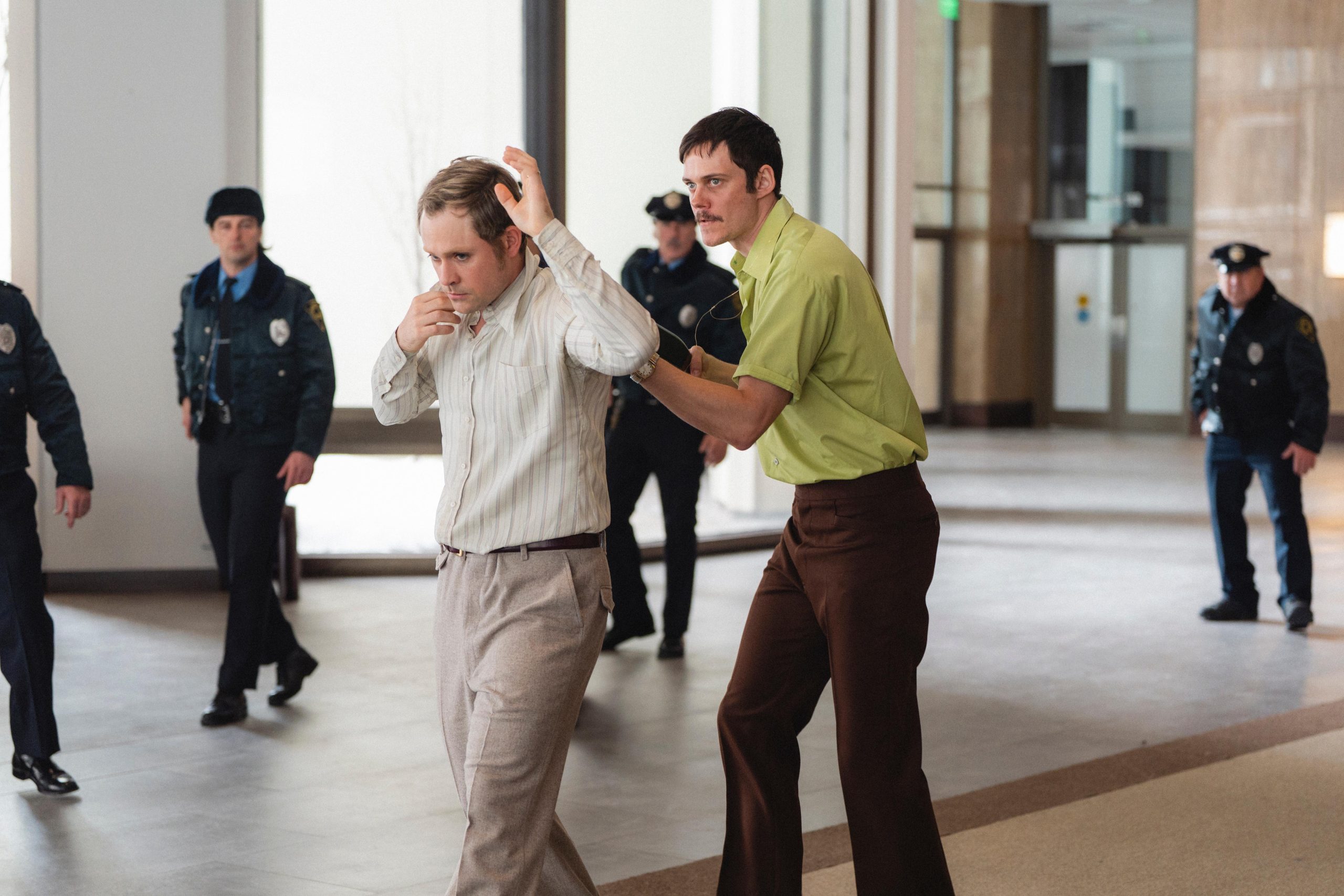
Some thrillers push buttons — this one pushes wires. Dead Man’s Wire is the kind of story that grabs hold early and never lets the tension drop, humming with quiet danger instead of loud chaos. It’s a slow, steady current of suspense where every word matters, every pause feels loaded, and one wrong move could end the call for good.
Plot
On February 8, 1977, Tony Kiritsis entered the office of Richard Hall, president of the Meridian Mortgage Company, and took him hostage with a sawed-off shotgun wired with a “dead man’s wire” from the trigger to Tony’s own neck.
Movie Review
Dead Man’s Wire doesn’t just ring with tension — it’s connected to a real-life line that once shocked an entire nation. From the outset, the film makes it clear that this isn’t merely a fictional thriller, but a dramatized retelling of one of the most disturbing and bizarre hostage standoffs in American history. Knowing that the events are rooted in truth gives every scene an added jolt, like handling a live wire you’re constantly warned not to touch.
The film is based on the 1977 case of Tony Kiritsis, a man who wired a sawed-off shotgun to the neck of a mortgage banker and demanded justice for what he believed was a financial betrayal. Dead Man’s Wire approaches this chilling premise with restraint and seriousness, opting to explore the psychological and social conditions that led to the incident rather than sensationalising it. The result is a tense, character-driven film that feels both intimate and unsettling.
At the centre of the story is Tony Kiritsis, played by Bill Skarsgård, portrayed as deeply intelligent, articulate, and profoundly unstable. He is not depicted as a cartoonish villain, but as a man consumed by grievance and a need to be heard. His calm demeanour is often more frightening than outright rage, especially as he justifies his actions with a disturbing sense of logic. The film carefully balances empathy with accountability, allowing the audience to understand Tony’s mindset without ever endorsing his choices.
Opposite him is the hostage, Richard Hall, portrayed by Dacre Montgomery, whose performance anchors the emotional weight of the film. Hall is portrayed as restrained, professional, and increasingly fragile as the ordeal drags on. His quiet fear, physical discomfort, and psychological exhaustion are conveyed with subtlety, making his suffering feel painfully real. The dynamic between captor and captive becomes the film’s emotional core — a tense relationship defined by power, proximity, and the ever-present threat of irreversible consequences.
The negotiators and law enforcement figures provide a crucial third perspective. Rather than being framed as heroic problem-solvers, they are depicted as cautious, conflicted individuals operating under unprecedented circumstances. Their frustration, moral uncertainty, and fear of making the wrong call add realism to the film, reinforcing how unprepared systems often are for crises driven by personal obsession rather than clear criminal intent.
Visually and technically, Dead Man’s Wire mirrors its historical roots. The cinematography favours naturalistic lighting and confined spaces, reinforcing the authenticity of the period and the claustrophobia of the situation. The film resists dramatic scoring, allowing silence and conversation to carry the tension. This stripped-back approach ensures that the focus remains firmly on character and consequence.
What ultimately elevates the film is its reflection on the era it portrays. Set against a backdrop of economic frustration and institutional mistrust, the story becomes more than a hostage thriller — it’s a study of what happens when personal grievances collide with public systems. The film quietly asks whether tragedy could have been avoided if communication, accountability, or intervention had arrived sooner.
By the time Dead Man’s Wire reaches its conclusion, the tension has been pulled taut, leaving behind a lingering unease. It’s a sobering reminder that some of the most frightening stories don’t come from imagination, but from history itself. And when the final connection is severed, the film leaves you with one clear message: some wires, once crossed, can never be safely cut. This movie deserves a 4.5 star rating.


James Mangold’s Swamp Thing Is Still Moving Forward at DC Studios
James Mangold’s long developing Swamp Thing movie is still alive at DC Studios, with studio co chairman Peter Safran confirming...


Ryan Coogler’s ‘The X-Files’ Reboot Officially Ordered to Series at Hulu
The truth is officially heading back out there. Hulu has given a full series order to Ryan Coogler’s upcoming reimagining...


Breaking Bad Star RJ Mitte Dies at 34
RJ Mitte, the actor best known for portraying Walter White Jr. on the acclaimed AMC series Breaking Bad, has died...


Greta Gerwig’s Narnia: The Magician’s Nephew Reveals First Epic Trailer
Netflix has officially opened the door to Narnia. The first trailer for Greta Gerwig’s Narnia: The Magician’s Nephew has arrived,...

Jeremy Allen White Says It Would Be an ‘Honor’ to Play Gene Wilder in Upcoming Biopic
Jeremy Allen White is ready to step into the shoes of legendary actor Gene Wilder, he just needs someone to...

Blumhouse Is Developing a Live-Action ‘Amanda the Adventurer’ Movie
Blumhouse is bringing another popular horror video game to the big screen. The studio is developing a live-action adaptation of...


